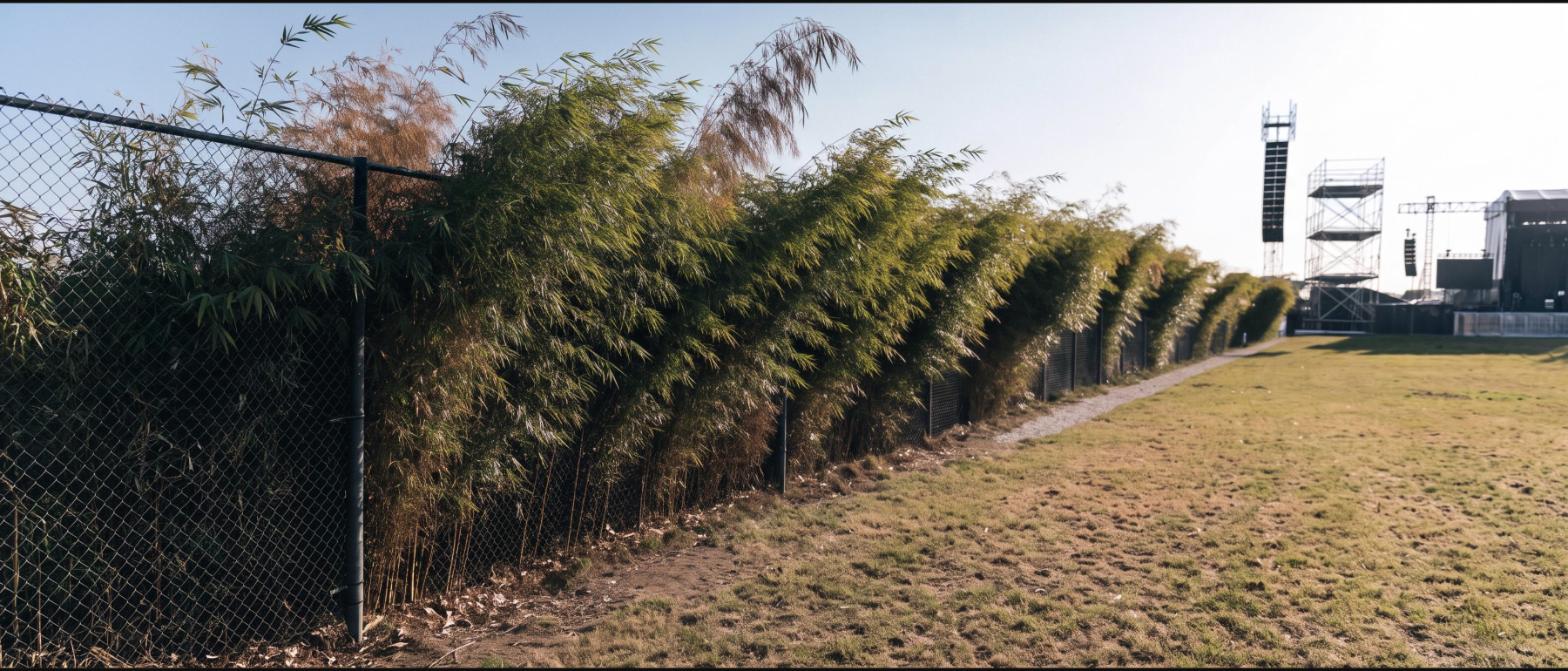
If you run an event on the same field every year, two complaints arrive after every edition. One is that the site looks like an industrial yard from the road. The other is that someone two fields over could hear the sub-bass at one in the morning.
A planted boundary solves the first one properly. It is worth being precise about why it does almost nothing for the second, because that confusion gets written into site plans and then into licence applications.
What It Genuinely Fixes
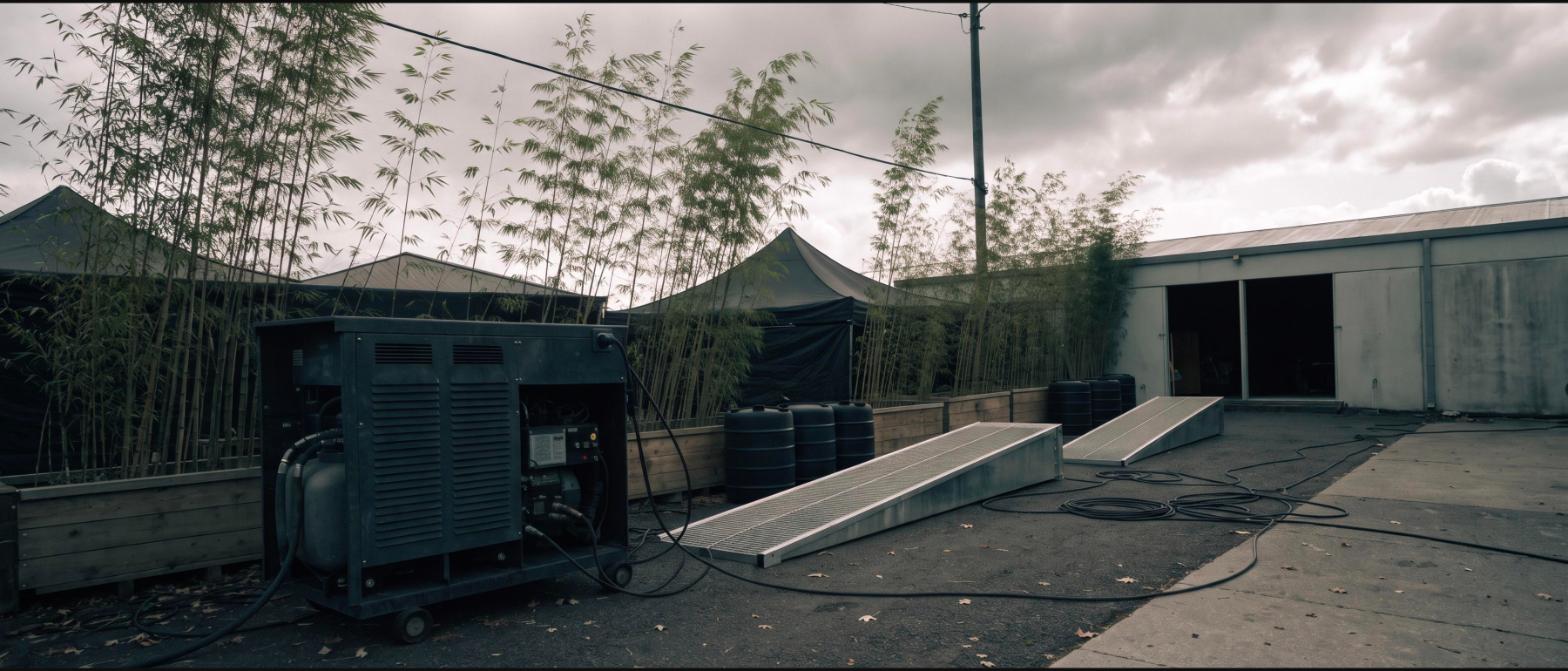
Sightlines, which matter more than people admit. Generators, cable ramps, water bowsers, the toilet service lane, the artist compound, the stack of Heras fence panels — all of it is visible from somewhere, and all of it is what the local objection photographs look like when they turn up at the licensing hearing.
A line of tall, narrow, evergreen planting screens that at eight to ten feet while taking up very little ground. Compared with scrim on fencing it survives wind better, does not flap, and does not need replacing after every event. For a returning site with a permanent perimeter, people planning bamboo plants for screening privacy along a boundary are usually buying it once rather than renting it annually.
What It Does Not Fix
Noise. Vegetation is a poor acoustic barrier, and the physics is not subtle. Attenuation needs mass and it needs a solid, gap-free surface. Leaves have almost no mass and a hedge is mostly air. Published figures for dense planting belts land somewhere around a couple of decibels, and you need a very deep belt of woodland — tens of metres — before you approach anything you would call a barrier.
Low frequencies make it worse. Long wavelengths diffract around objects far smaller than the wavelength, and a 40 Hz tone has a wavelength of roughly eight and a half metres. It goes through and around a hedge as though the hedge is not there. The content your complaints are actually about is the content vegetation is least able to touch.
There is one real effect worth naming honestly: people who cannot see a noise source consistently report it as less annoying than people who can, at identical measured levels. That is a psychoacoustic result, not an acoustic one. It may genuinely reduce complaints. It will not move the meter at the nearest noise-sensitive receptor, and it should never be presented to a licensing officer as mitigation.

Watch: Trees and the Sound Barrier (YouTube)
Two Practical Notes
Choose clumping species, not running ones. Running bamboo spreads by rhizome into neighbouring land, and a boundary dispute with the farmer you lease from is a worse problem than the one you were solving.
And give it time. A screen that actually screens takes two or three growing seasons. If your next edition is in eight months, the bamboo is for the edition after that — put scrim up this year and plant for the long run.
For noise, spend the money where the physics is: source orientation, delay towers so you can run the main stacks quieter, cardioid sub arrays, and a curfew you actually keep.